
All-on-4 vs. All-on-6 Dental Implants: Which Is Right for You?
By Envision Dental Spa
Published September 14, 2026
Full-arch dental implants have changed what’s possible for patients missing most or all of their teeth — a fixed, permanent set of teeth anchored by a handful of implants instead of a removable denture. But once you start researching, you’ll run into two common approaches: All-on-4 and All-on-6. Here’s how we actually decide which one fits a given patient.
The Core Idea Is the Same
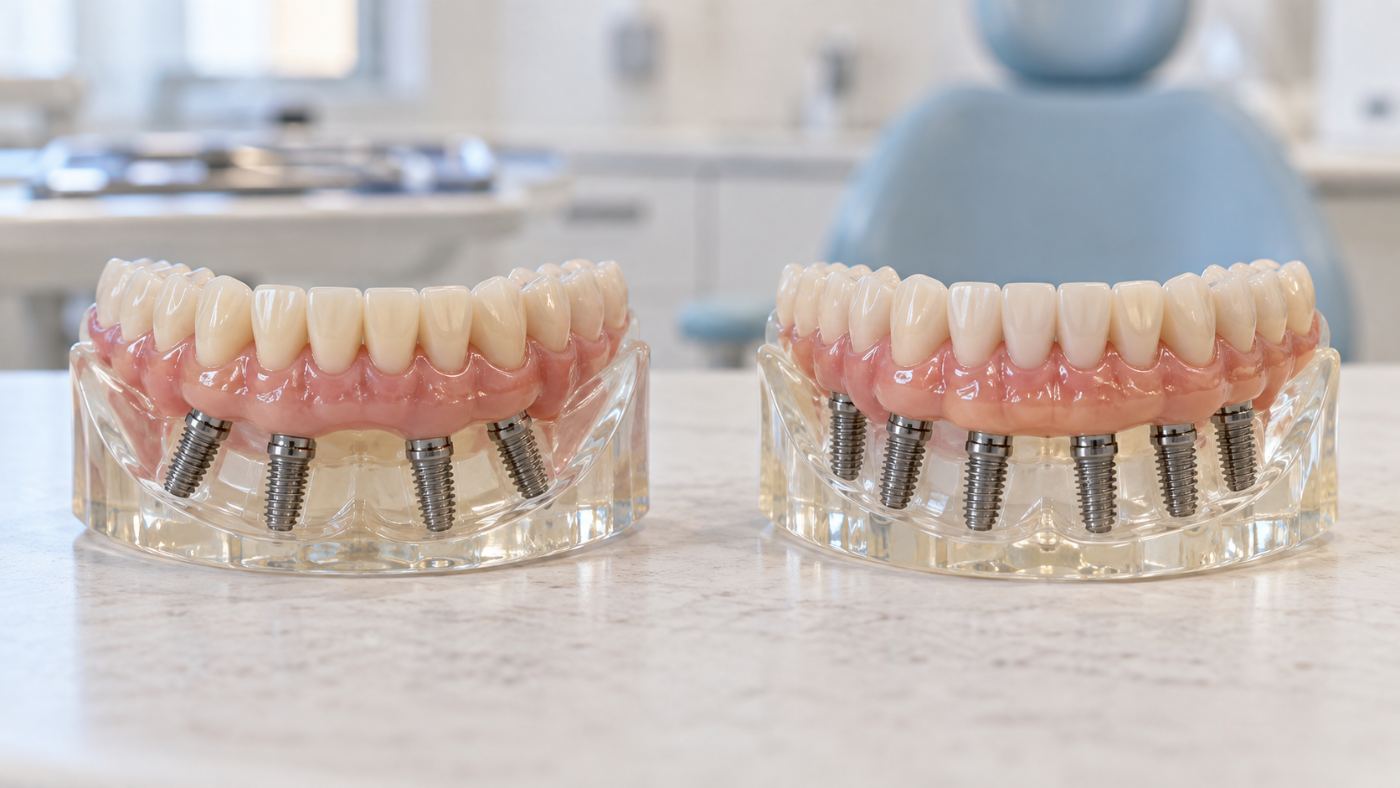
Both approaches replace a full arch of missing teeth with a fixed prosthetic supported by strategically placed implants, rather than one implant per missing tooth. The difference is simply how many implants anchor that arch — four, or six.
All-on-4: The Original Full-Arch Technique
All-on-4 revolutionized implant dentistry by proving that a full arch could be securely supported with just four implants, angled to maximize contact with existing bone (often avoiding the need for bone grafting even in patients with some bone loss).
Best suited for
- Patients with adequate bone density in the front of the jaw, even if bone has thinned toward the back
- Patients who want to avoid a bone graft if possible
- Cases where a faster, more cost-effective full-arch solution is the priority
All-on-6: More Support Points
The concept behind All-on-6 is straightforward: instead of four implants supporting the entire arch, six implants are distributed across the jaw. From a biomechanical standpoint, more support points allow chewing forces to be spread more evenly, which can reduce the load carried by each individual implant.
Best suited for
- Patients with strong bite forces or a history of bruxism (teeth grinding/clenching)
- Cases needing additional stability, particularly in the lower arch
- Patients with good bone volume across more of the jaw, who can support the additional implants without extensive grafting
Side-by-Side Comparison
| All-on-4 | All-on-6 | |
|---|---|---|
| Number of implants per arch | 4 | 6 |
| Typical cost per arch | Lower | Higher |
| Bone requirement | Lower — works well even with some bone loss | Higher — needs more available bone across the arch |
| Load distribution | Concentrated on 4 points | Spread across 6 points |
| Best for | Straightforward cases, cost-conscious patients | Heavy bite forces, bruxism, added long-term stability |
| Treatment timeline | Similar | Similar, occasionally slightly longer if more sites need preparation |
So Which One Is Actually Right for You?
All-on-6 is not automatically the “better” or “safer” option. In modern implant dentistry, the goal isn’t to place as many implants as possible — it’s to choose the biomechanics that are correct for your specific jaw, bite, and bone structure.
A patient with excellent bone density and a normal bite may do perfectly well, and save meaningfully on cost, with All-on-4. A patient with a heavy bite or additional risk factors may genuinely benefit from the extra stability of All-on-6.
This is a decision that should be made from a 3D scan of your jaw, not a general rule — which is exactly what your consultation is for.
What About “Teeth in 24 Hours”?
Both All-on-4 and All-on-6 can sometimes be paired with same-day provisional teeth, so you can leave surgery with a functional, good-looking temporary set while your final restoration is fabricated. That said, be cautious of marketing that promises permanent, final teeth in 24 hours — most legitimate full-arch cases still require a healing period before the final, permanent prosthetic is placed, regardless of how many implants are used.
Want to know which approach fits your case?
Schedule a consultation with Envision Dental Spa for a 3D scan and a straightforward recommendation — not a one-size-fits-all sales pitch.
Schedule a ConsultationFrequently Asked Questions
Envision Dental Spa — your trusted cosmetic and implant dentistry practice in Arlington, Texas. This post is for general educational purposes and isn’t a substitute for a personalized consultation.